Designing Process for High-Performance Product Design Teams

Designing Process for High-Performance Product Design Teams

✦ 8 min read ✦ Design Leadership  

Most design teams don’t struggle because of a lack of talent—they struggle because they lack the processes that create clarity, predictability, and alignment with business outcomes.

Over the past year, leading product design for a fast-growing eCommerce and payments platform, I built a process framework that enabled us to consistently influence our company’s north star metrics, it also helped us shorten design sprints from two weeks to one, and increase task completion by over 30%.

Here’s the simplified version of that system - something any design lead can adapt.
Most design teams don’t struggle because of a lack of talent—they struggle because they lack the processes that create clarity, predictability, and alignment with business outcomes.

Over the past year, leading product design for a fast-growing eCommerce and payments platform, I built a process framework that enabled us to consistently influence our company’s north star metrics, it also helped us shorten design sprints from two weeks to one, and increase task completion by over 30%.

Here’s the simplified version of that system - something any design lead can adapt.

Start With the Business: Work Backwards From North Star Metrics

North star metrics like Monthly Active Customers or payment success rate are lagging indicators. They only move days or weeks after the work is done, and sometimes the signal is blurred by seasonal trends or external variables.

So instead, design teams need leading indicators—activities they can track weekly that reliably influence those outcomes.

To find the leading indicators, I start with three questions:

01

What business outcomes are we responsible for?

01

What business outcomes are we responsible for?

02

What activities within the team influence those outcomes?

02

What activities within the team influence those outcomes?

03

How do we measure those team activities in real time?

03

How do we measure those team activities in real time?

In summary, what can we measure today that predicts whether our north star metrics will move tomorrow? The answers form our leading indicators.

We can then feed the answer into a framework that helps operationalize the design team.

Start With the Business: Work Backwards From North Star Metrics

North star metrics like Monthly Active Customers or payment success rate are lagging indicators. They only move days or weeks after the work is done, and sometimes the signal is blurred by seasonal trends or external variables.

So instead, design teams need leading indicators—activities they can track weekly that reliably influence those outcomes.

To find the leading indicators, I start with three questions:

01

What business outcomes are we responsible for?

02

What activities within the team influence those outcomes?

03

How do we measure those team activities in real time?

In summary, what can we measure today that predicts whether our north star metrics will move tomorrow? The answers form our leading indicators.

We can then feed the answer into a framework that helps operationalize the design team.

A Simple Three-Layer Operating Framework

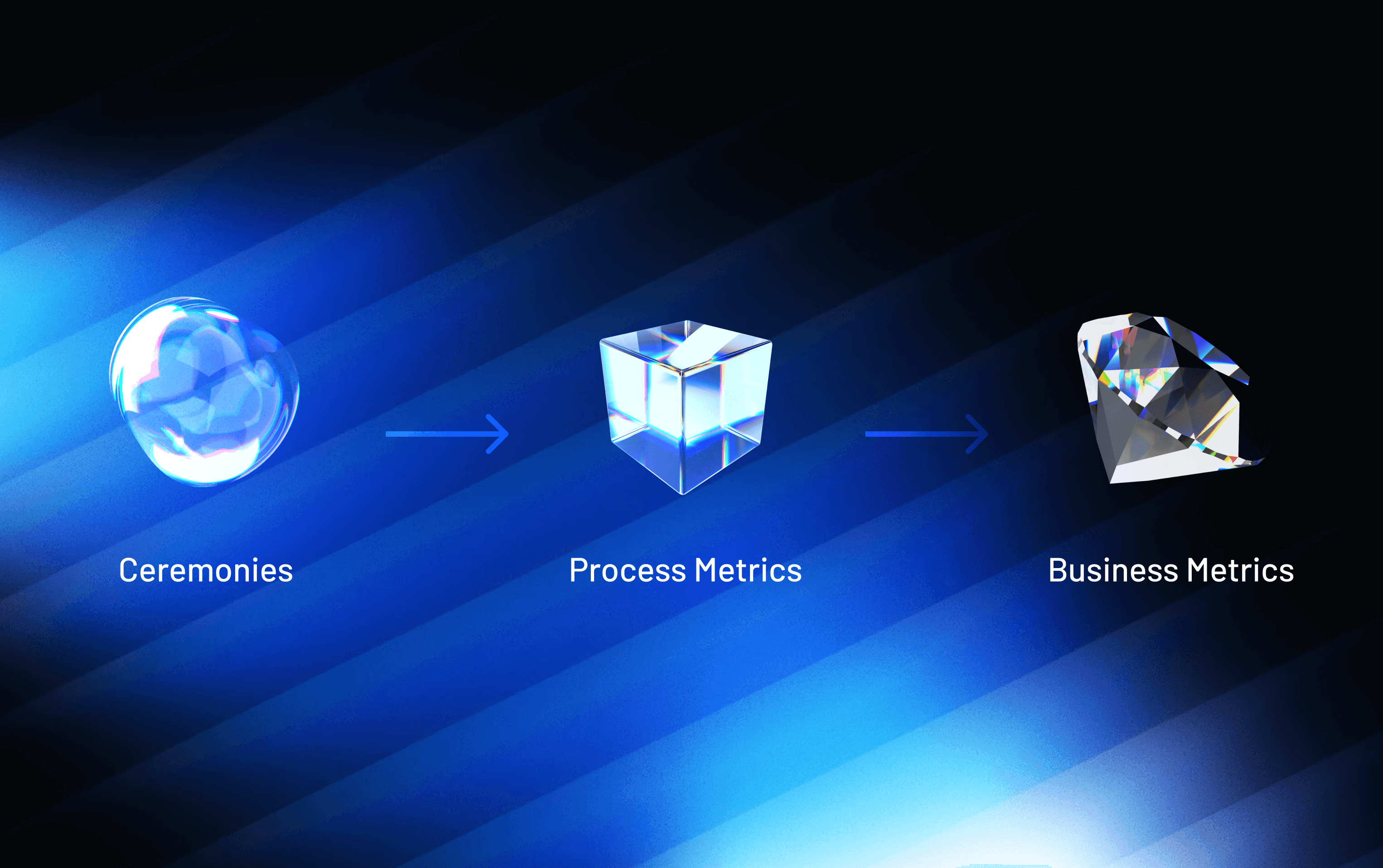
I run my team using a simple but effective three-layer structure, each feeding the next:

01

Ceremonies – Structured rituals that keep the team aligned, learning, and continuously improving.

01

Ceremonies – Structured rituals that keep the team aligned, learning, and continuously improving.

02

Process Metrics – the leading indicators we measure from ceremonies that show whether we’re operating in a healthy, predictable way.

02

Process Metrics – the leading indicators we measure from ceremonies that show whether we’re operating in a healthy, predictable way.

03

Business Metrics – your company’s lagging indicators (MAC, revenue, conversion, retention) that ultimately determine product success.

03

Business Metrics – your company’s lagging indicators (MAC, revenue, conversion, retention) that ultimately determine product success.

Image featuring a greyscaled ux panel on an abstract background.

The magic of this structure lies in the fact that each layer feeds the next.
Ceremonies → influence process metrics → influence business metrics.

When the first two layers are strong, the third almost always follows.

So let's look briefly at the ceremonies and process metrics.

A Simple Three-Layer Operating Framework

I run my team using a simple but effective three-layer structure, each feeding the next:

01

Ceremonies – Structured rituals that keep the team aligned, learning, and continuously improving.

02

Process Metrics – the leading indicators we measure from ceremonies that show whether we’re operating in a healthy, predictable way.

03

Business Metrics – your company’s lagging indicators (MAC, revenue, conversion, retention) that ultimately determine product success.

Image featuring a greyscaled ux panel on an abstract background.

The magic of this structure lies in the fact that each layer feeds the next.
Ceremonies → influence process metrics → influence business metrics.

When the first two layers are strong, the third almost always follows.

So let's look briefly at the ceremonies and process metrics.

Layer 1: Ceremonies That Create Predictability

I split ceremonies into two categories:

Product & Project Ceremonies

These ensure predictability, alignment, and high-velocity execution.

  • Daily Standup (15 min): What was done, what’s next, what’s blocked so we can maintain momentum and eliminate blockers early.

  • Weekly Sprint Planning (30 min): Prioritize tasks aligned with PMs and engineering.

  • Design Critique (Twice a week): Improve craft, quality, rationale, and consistency.

  • Weekly Design Review with PMs:  Designers articulate design decisions using insights & data. Ensures PM alignment before engineering grooming.

  • Weekly Grooming with Engineers: Prevents misinterpretation, clarifies constraints, and reduces rework.

  • Weekly Platform Trio (VP Product + Eng. Lead + Design): Align roadmap priorities across functions.

  • Monthly Design QA: Ensure implementation matches design intent.

  • Monthly Retro: What worked, what didn’t, what to improve.

People & Learning Ceremonies

These ensure sustained growth and well-being, essential for long-term performance.

  • Weekly Study Session: One hour dedicated to learning—courses, case studies, best practices.

  • Weekly 1:1s: Support well-being, unblock issues, track career development.

  • Monthly Data Review: Analyze metrics like conversion, bounce, retention.

  • Monthly Research/Experimentation: User interviews, A/B tests, focus groups and other forms of insight gathering.


These ceremonies form the "inputs", but the value comes from what we measure through them, the "Process Metrics".

Layer 1: Ceremonies That Create Predictability

I split ceremonies into two categories:

Product & Project Ceremonies

These ensure predictability, alignment, and high-velocity execution.

  • Daily Standup (15 min): What was done, what’s next, what’s blocked so we can maintain momentum and eliminate blockers early.

  • Weekly Sprint Planning (30 min): Prioritize tasks aligned with PMs and engineering.

  • Design Critique (Twice a week): Improve craft, quality, rationale, and consistency.

  • Weekly Design Review with PMs:  Designers articulate design decisions using insights & data. Ensures PM alignment before engineering grooming.

  • Weekly Grooming with Engineers: Prevents misinterpretation, clarifies constraints, and reduces rework.

  • Weekly Platform Trio (VP Product + Eng. Lead + Design): Align roadmap priorities across functions.

  • Monthly Design QA: Ensure implementation matches design intent.

  • Monthly Retro: What worked, what didn’t, what to improve.

People & Learning Ceremonies

These ensure sustained growth and well-being, essential for long-term performance.

  • Weekly Study Session: One hour dedicated to learning—courses, case studies, best practices.

  • Weekly 1:1s: Support well-being, unblock issues, track career development.

  • Monthly Data Review: Analyze metrics like conversion, bounce, retention.

  • Monthly Research/Experimentation: User interviews, A/B tests, focus groups and other forms of insight gathering.


These ceremonies form the "inputs", but the value comes from what we measure through them, the "Process Metrics".

Layer 2: Process Metrics That Predict Success

These are the leading metrics I track weekly or monthly from the ceremonies, and each metric helps answer key questions.

01

Number of agreed tasks

01

Number of agreed tasks

02

Rate of change of tasks during sprints (Target: 0%)

02

Rate of change of tasks during sprints (Target: 0%)

03

Task completion rate within the sprints (Target: 100%)

03

Task completion rate within the sprints (Target: 100%)

These first three metrics answer the questions :

✦ Are we working on the right things in the right order?

✦ Are we completing work predictably?

A helpful artifact here is a "Sprint Alignment Service Level Agreement" document. View sample I prepared here.

04

Number of planned experiments

04

Number of planned experiments

05

Experiment completion rate (Target: 100%)

05

Experiment completion rate (Target: 100%)

06

Experiment to insight conversion rate (Target: 100%)

06

Experiment to insight conversion rate (Target: 100%)

07

Validated data on Bounce rate, Conversion rate, and Average days to second purchase

07

Validated data on Bounce rate, Conversion rate, and Average days to second purchase

These four metrics answer the questions :

✦ Are we gathering validated user insights?

✦ Are we gathering validated data insights?

08

Course completion rate

08

Course completion rate

09

Certification completion

09

Certification completion

10

Number of attended conferences

10

Number of attended conferences

These answer the question :

✦ Are the designers upskilling at the right pace?

A helpful artifact here is a "Learning and growth SLA" document. View sample I prepared here.

11

Number of issues raised vs. resolved via 1:1 and retros

11

Number of issues raised vs. resolved via 1:1 and retros

This answers the question :

✦ Are we ensuring designers well-being?

Layer 2: Process Metrics That Predict Success

These are the leading metrics I track weekly or monthly from the ceremonies, and each metric helps answer key questions.

01

Number of agreed tasks

02

Rate of change of tasks during sprints (Target: 0%)

03

Task completion rate within the sprints (Target: 100%)

These first three metrics answer the questions :

✦ Are we working on the right things in the right order?

✦ Are we completing work predictably?

A helpful artifact here is a "Sprint Alignment Service Level Agreement" document. View sample I prepared here.

04

Number of planned experiments

05

Experiment completion rate (Target: 100%)

06

Experiment to insight conversion rate (Target: 100%)

07

Validated data on Bounce rate, Conversion rate, and Average days to second purchase

These four metrics answer the questions :

✦ Are we gathering validated user insights?

✦ Are we gathering validated data insights?

08

Course completion rate

09

Certification completion

10

Number of attended conferences

These answer the question :

✦ Are the designers upskilling at the right pace?

A helpful artifact here is a "Learning and growth SLA" document. View sample I prepared here.

11

Number of issues raised vs. resolved via 1:1 and retros

This answers the question :

✦ Are we ensuring designers well-being?

The Results

When ceremonies bring clarity and leading metrics build predictability, teams feel supported — and the business feels the impact.

After all, when leading metrics improve, business outcomes almost always follow.

Click and zoom in here to see what the process map looks like.

The Results

When ceremonies bring clarity and leading metrics build predictability, teams feel supported — and the business feels the impact.

After all, when leading metrics improve, business outcomes almost always follow.

Click and zoom in here to see what the process map looks like.

Why This System Works

It works because it blends several working principles:

  • Systems Thinking

It mirrors the Input -> Processes -> Outputs framework of systems thinking.

  • Leading vs. Lagging Indicator Theory

It borrows from classic models such as OKRs, Lean Analytics that are used by high-performing teams.

  • Continuous Improvement (Kaizen)

The system keeps evolving as we measure week by week, and the improvements compound our progress, keeping the team efficient in the short term and impactful in the long term.

Why This System Works

It works because it blends several working principles:

  • Systems Thinking

It mirrors the Input -> Processes -> Outputs framework of systems thinking.

  • Leading vs. Lagging Indicator Theory

It borrows from classic models such as OKRs, Lean Analytics that are used by high-performing teams.

  • Continuous Improvement (Kaizen)

The system keeps evolving as we measure week by week, and the improvements compound our progress, keeping the team efficient in the short term and impactful in the long term.